“Why is Karuppu Kavuni so chewy?”
“Can I eat it with sambar?”
“Is it really healthier than regular white rice?”
These are some of the most common questions we hear from customers.
If you’ve ever tried Karuppu Kavuni for the first time, you may have noticed that it feels very different from the white rice most of us grew up eating. It is darker, firmer, slightly chewy, and has a unique nutty flavour.
Some people immediately love it. Others wonder if they are cooking it incorrectly.
The truth is that this difference is exactly what makes Karuppu Kavuni special.
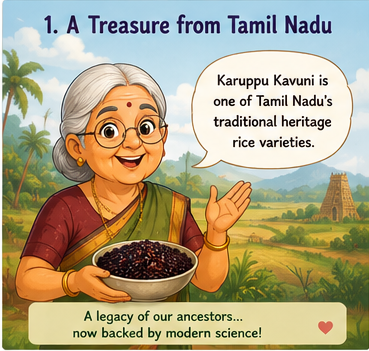
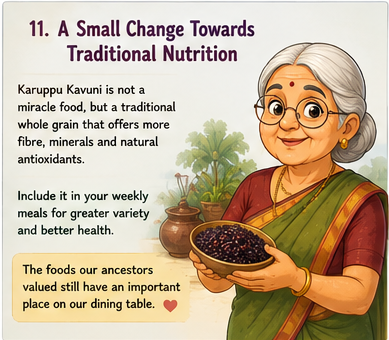
Karuppu Kavuni is one of Tamil Nadu’s traditional heritage rice varieties. For generations, it was valued not only as food but also for its nutritional richness. Unlike polished white rice, Karuppu Kavuni retains much of its natural bran layer, where many valuable nutrients are found.
Modern scientific studies conducted by researchers, including those from Tamil Nadu Agricultural University (TNAU), have confirmed that Karuppu Kavuni contains significantly higher levels of fibre, minerals and natural antioxidants than commonly consumed polished white rice varieties such as White Ponni, IR64 and CO 50.
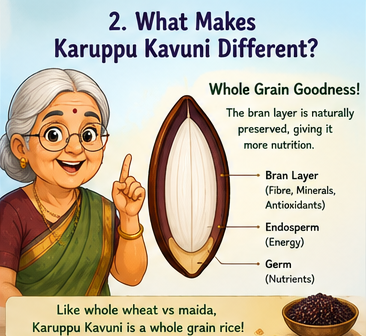
Think about the difference between whole wheat flour and refined maida.
Whole wheat flour contains the bran and germ, making it richer in fibre and nutrients. Refined maida is softer because those outer layers have been removed.
Karuppu Kavuni follows the same principle.
Its bran layer is naturally preserved, giving the grain its distinctive black-purple colour, chewy texture and impressive nutritional profile.
The bran contains valuable compounds such as:
These are largely reduced when rice is heavily polished.
So, while polished white rice cooks softer, Karuppu Kavuni offers more of the grain’s natural goodness.
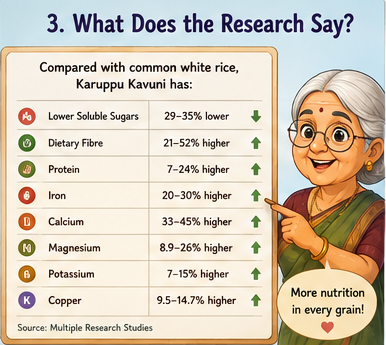
Several peer-reviewed studies have compared Karuppu Kavuni with commonly consumed white rice varieties. The findings consistently show higher nutritional value.
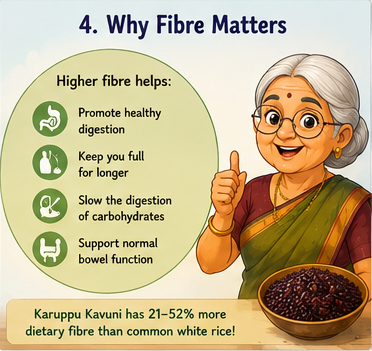
For families looking to include more whole foods in their meals, this is one of Karuppu Kavuni’s greatest strengths.
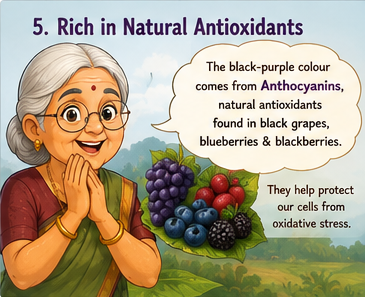
Unlike polished white rice, which contains very little of these compounds, Karuppu Kavuni naturally retains them because its bran layer is preserved.
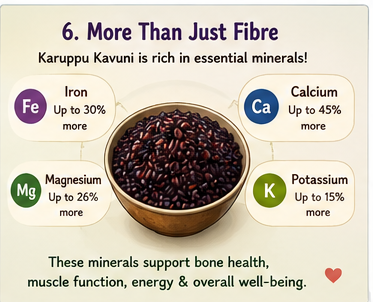
Compared with common white rice, research has reported these essential minerals
These nutrients contribute to normal body functions such as bone health, muscle function, energy metabolism and oxygen transport.
Many first-time users assume the rice is undercooked.
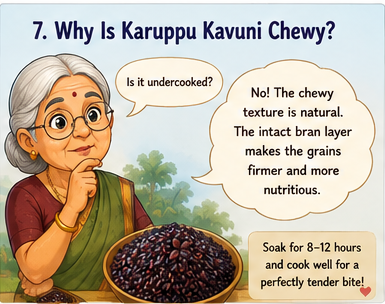
In reality, the chewy texture is one of its natural characteristics.
Because the nutritious bran layer remains intact, the grains are naturally firmer than polished white rice. This is not a quality issue—it is a sign that the grain has retained more of its original structure.
After soaking for 8–12 hours and cooking thoroughly, Karuppu Kavuni becomes pleasantly tender while still maintaining its signature bite.
Rather than expecting it to feel like White Ponni rice, think of it as a wholesome whole grain with its own unique texture.
This is probably the most common question we receive.
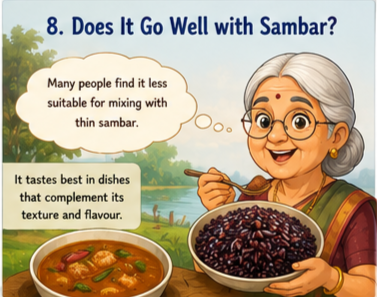
The honest answer is that many people find Karuppu Kavuni less suitable for mixing directly with thin sambar compared with polished white rice.
Instead of forcing it to replace white rice in every meal, it is better to enjoy it in dishes that naturally complement its texture.
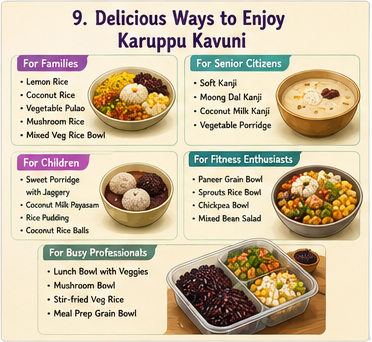
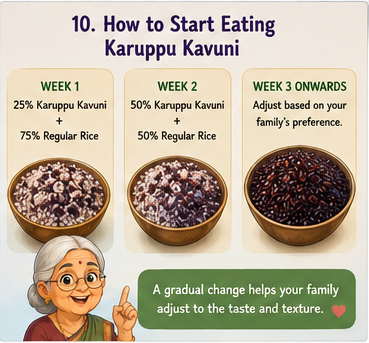
If you are new to this traditional rice, there is no need to replace your regular rice overnight. Follow the simple approach