
Mankatti Sambar Paruppu is a traditional Semmann processed Toor Dal prepared using an age-old red soil dehusking method practiced in Tamil Nadu. Unlike heavily polished commercial toor dal, Mankatti Sambar Paruppu retains more of the grain’s natural outer cotyledon, giving it a richer aroma, authentic flavour, and natural appearance. At Sanjeevi Life, we also offer a range of traditional rice varieties that are minimally processed using time-tested methods.
Many people assume that brighter dal is of better quality. In reality, the appearance of Mankatti Sambar Paruppu reflects a traditional processing method that uses Semmann (clean red soil) and gentle dehusking, helping preserve more of the grain’s natural characteristics.
Mankatti Sambar Paruppu is a traditional form of Toor dal prepared using the age-old Semmann (Red soil) processing method. Unlike modern commercial polishing, this method removes only the husk while retaining more of the grain’s natural outer cotyledon.
The result is a dal that retains its authentic appearance, develops a richer aroma during cooking, and reflects the traditional methods practised by generations of farmers.
Before modern dhal mills became widespread, farmers relied on a simple yet ingenious technique to remove the husk from pigeon peas without excessive polishing.
Instead of repeatedly polishing the grains, this method naturally loosened the husk, allowing it to be removed gently while preserving more of the outer layer.
The use of clean red soil was not accidental. It served several practical purposes:
This traditional method reduced the need for abrasive polishing and helped preserve the natural characteristics of the dal.
Modern commercial dhal mills often remove not only the husk but also part of the outer cotyledon.
Although this creates a bright, uniform yellow appearance, it also removes some naturally occurring compounds found in the grain’s outer layers.
One of the distinguishing characteristics of Mankatti Sambar Paruppu is its rich aroma and authentic flavour after cooking. This is closely associated with the traditional Semmann processing method, which involves minimal polishing.
Research on pigeon pea (Cajanus cajan) has identified several naturally occurring phenolic compounds in the seed coat and outer cotyledon, including:
These are naturally occurring bioactive compounds with antioxidant properties. The study further reported that the seed coat contains the highest concentration of phenolic compounds, the outer cotyledon contains moderate amounts, while the inner cotyledon contains comparatively lower amounts.
During the preparation of Mankatti Sambar Paruppu, the seed coat is removed as part of the dehusking process. However, unlike heavily polished commercial toor dal, the traditional Semmann processing method uses minimal polishing, allowing more of the outer cotyledon to remain.
The retained outer cotyledon naturally contains phenolic compounds, flavonoids and surface lipids, which contribute to the dal’s distinctive qualities, including:
By preserving more of these naturally occurring compounds, traditional Mankatti Sambar Paruppu develops the characteristic aroma and flavour that have been appreciated in traditional kitchens for generations.
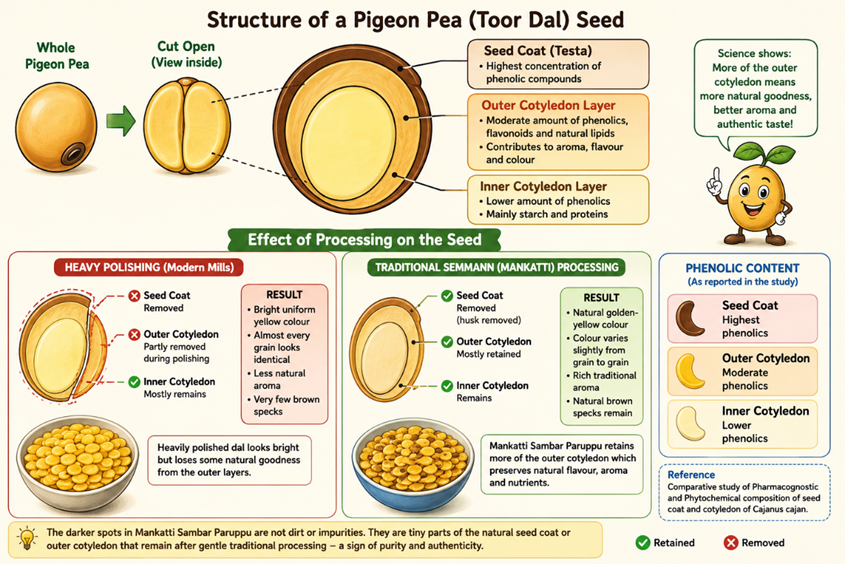
Comparative Study of Pharmacognostic and Phytochemical Composition of Seed Coat and Cotyledon of Cajanus cajan.
Many customers ask:
“Why are there small brown spots on the dal?”
The answer is simple.
The darker specks are not dirt, dust or impurities.
They are tiny portions of the natural seed coat or outer cotyledon that remain after gentle traditional processing.
These natural variations are actually a sign that the dal has not been heavily polished.
Mankatti Sambar Paruppu vs Regular Polished Toor Dal
| Regular Polished Toor Dal | Mankatti Sambar Paruppu |
| Bright uniform yellow colour | Natural golden-yellow colour |
| Almost every grain looks identical | Natural variation between grains |
| Heavy polishing | Minimal polishing |
| Very few natural outer layers remain | More of the outer cotyledon retained |
| Mild aroma | Rich traditional aroma |
| Smooth appearance | Natural brown specks may be present |
At Sanjeevi Life, we source Siru Thuvarai and Perunthuvarai from farmers who continue to practise Manavari (rainfed) cultivation without chemical fertilisers.
Unlike intensive irrigated farming, rainfed cultivation depends on seasonal rainfall. The crop grows gradually, allowing roots to reach deeper into the soil while interacting naturally with beneficial soil microorganisms.
Traditional foods with core and minimal processing helps to lead a healthy life. Traditional foods with minimal processing help preserve their natural characteristics… If you enjoy traditional foods, you may also be interested in our Traditional Rice Collection.
After learning about the traditional Semmann processing method and the unique characteristics of Mankatti Sambar Paruppu, you can experience its authentic taste in your own kitchen.
Why choose Sanjeevi Life?
👉 Buy Mankatti Sambar Paruppu from Sanjeevi Life
Related Articles: –